
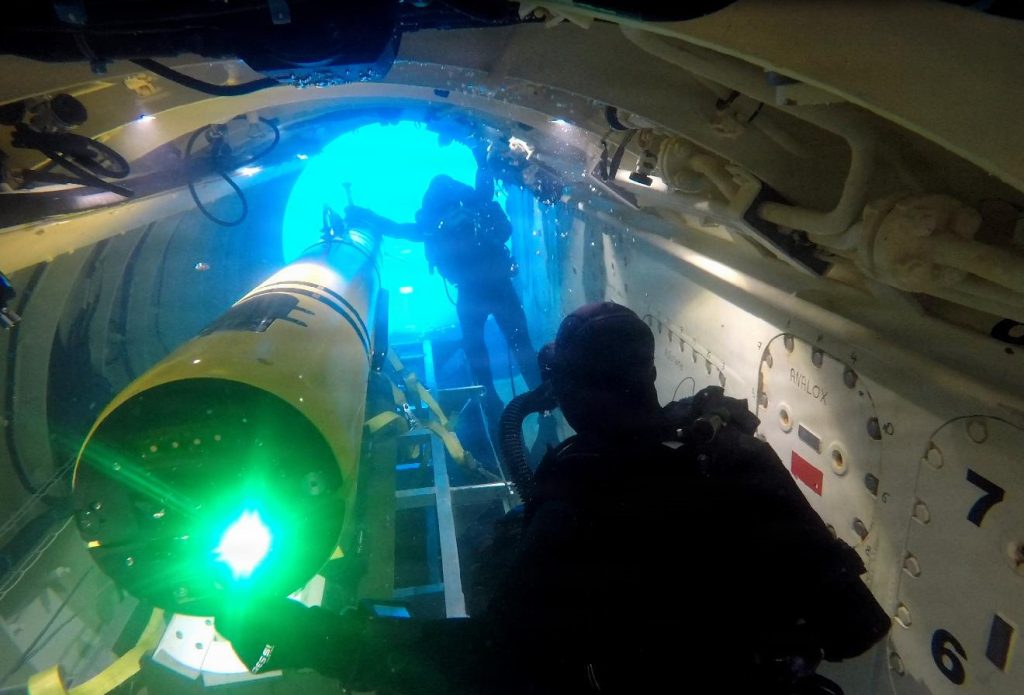
The U.S. and French navies successfully launched an American Razorback underwater drone from a French nuclear submarine in the Atlantic. This joint operation demonstrates their strong alliance and advanced technical ability to deploy U.S. assets from allied platforms, significantly enhancing their combined undersea warfare capabilities.
The strategic problem: the Navy needs maritime mass, fast
The U.S. Navy and its allies are facing a maritime force-structure problem: they need more sensing, more persistence, more distributed presence, and more survivable capacity without putting more sailors into every high-risk mission. That is why unmanned surface vehicles, or USVs, and unmanned undersea vehicles, or UUVs, have moved from niche experimentation into serious fleet planning.
A USV, or unmanned surface vehicle, operates on the water’s surface. A UUV, or unmanned undersea vehicle, operates below the surface. Together, these platforms support mine countermeasures, intelligence, surveillance and reconnaissance, anti-submarine warfare, seabed sensing, electronic warfare, logistics, harbor defense, special operations, and distributed maritime operations.
The public demand signal is now clear. The Navy and Defense Innovation Unit have been working together to prototype and field small unmanned surface vehicles under the Replicator initiative, explicitly evaluating vendors for production capacity, manufacturing readiness, vehicle performance, autonomy, and readiness for high-rate production. More than 100 applicants competed for those small USV opportunities, showing how quickly the market is shifting from one-off demonstrations to scalable production.
The same transition is happening undersea. DIU and NAVSEA’s PMS 394 selected Oceaneering International, Kongsberg Discovery, and Anduril Industries for large-displacement UUV work, with the Navy describing undersea warfare as especially important in Pacific and contested environments.
For domestic manufacturers in the Northeast United States, this is not an abstract defense trend. It is a direct supply-chain opportunity.
The U.S. does not only need more hulls. It needs more qualified components, more rapid-turn machined parts, more custom magnetics, more metal fabrication, more test fixtures, more electronics enclosures, more launch-and-recovery structures, and more sustainment spares that can survive saltwater, shock, vibration, pressure, corrosion, electromagnetic interference, and defense traceability requirements.
Why USV and UUV fleet growth is accelerating
1. DoD and DIU are pushing autonomy into production
The Department of Defense’s Replicator initiative is designed to accelerate all-domain attritable autonomous systems, and the maritime domain is one of the most visible areas of activity. For small USVs, DIU and the Navy awarded contracts to a mix of mid-sized, nontraditional, and venture-backed companies, while emphasizing a diversified vendor base and faster acquisition pathways.
This matters because unmanned maritime systems are not being treated only as long-cycle shipbuilding programs. They are being treated as systems that must be manufactured, iterated, upgraded, and fielded at software-and-hardware speed.
That creates demand for suppliers that can move quickly from prototype to low-rate initial production to repeatable production.
2. NAVSEA is building the operational backbone
NAVSEA and the Navy’s unmanned maritime organizations are turning autonomy into deployable fleet capability. The Navy’s small USV family of systems includes platforms such as the Global Autonomous Reconnaissance Craft, or GARC, and the sUSV Next effort. GARC production was supported through APFIT rapid procurement, while sUSV Next emphasizes autonomy, collaborative behavior, open architectures, and fleet-ready production contracts.
The Navy has also tied small USVs directly to operational experimentation and fleet use. During a visit to BlackSea Technologies’ Baltimore production facilities, the Chief of Naval Operations saw how the company supports the Navy’s small USV program and expansion plans. The Navy described small USVs as force multipliers and noted that unmanned maritime systems are increasingly being assigned to unmanned surface vessel squadrons.
Mine countermeasures are another major driver. The Navy’s Mine Countermeasures USV is a long-endurance, semi-autonomous, diesel-powered, all-aluminum platform designed to carry modular mine-countermeasure payloads while keeping sailors farther from mine threats. As of the Navy’s public fact file, nine MCM USVs had been delivered to the Fleet, 18 were under contract, and the final inventory target was 48 systems.
That one fact alone explains why metal fabrication, marine aluminum work, precision machining, power systems, payload integration, and sustainment manufacturing matter now.
3. UUVs are moving from prototype to program scale
The Lionfish small UUV program is one of the clearest public examples of UUV production scaling. DIU, PEO Unmanned and Small Combatants, PMS 408, and Navy information warfare partners moved Lionfish from prototype OTA into a Navy production contract. HII’s REMUS 300-based Lionfish contract has a reported ceiling of $347 million, with deliveries planned through 2028.
HII later announced that it delivered the first two Lionfish small UUVs to the U.S. Navy from its Pocasset, Massachusetts, uncrewed systems facility. The company stated that the program could scale to as many as 200 vehicles and that Lionfish supports missions including mine countermeasures, ISR, anti-submarine warfare, and electronic warfare.
This is exactly the kind of program that turns local manufacturing capacity into national security capacity. A UUV production line needs pressure-tolerant components, corrosion-resistant machined parts, payload frames, electronics housings, battery-support structures, magnetic components, cable assemblies, test stands, jigs, fixtures, and spares.
4. DARPA is creating the next design frontier
DARPA is not simply funding “better boats.” It is challenging the assumptions of naval design.
The Manta Ray program demonstrated a full-scale UUV prototype during in-water testing in 2024, showing hydrodynamic performance, submerged operations, propulsion, steering, modular transport, field assembly, payload bays, and long-duration undersea design concepts. DARPA describes Manta Ray as a new class of long-duration, long-range, payload-capable UUVs intended for persistent operations.
The NOMARS program, short for No Manning Required Ship, produced USX-1 Defiant, a 180-foot, 240-metric-ton medium unmanned surface vessel designed from the beginning with no humans aboard. DARPA states that removing human-support requirements can improve size, cost, reliability, hydrodynamics, survivability, and scaled production potential.
Defiant later completed major at-sea activities including autonomous open-ocean transit, final acceptance trials, fueling-at-sea demonstrations, high-speed turns, dockings, harbor entries, and harbor exits. DARPA also emphasized that the vessel was designed for rapid production and maintenance in nearly any port or Tier III shipyard.
For manufacturers, DARPA’s message is important: future unmanned maritime platforms may not look like crewed vessels. They may use new hull forms, new modular payload structures, new internal architectures, and new sustainment models. That rewards suppliers who can build custom parts quickly and collaborate early on design-for-manufacturing.
5. SOF AT&L needs expeditionary, modular, low-signature systems
Special Operations Forces have their own USV and UUV requirements. USSOCOM’s public capability areas call for advanced unmanned surface systems that are expeditionary, platform-agnostic, scalable, built on open-system architectures, equipped with modular payloads, and supported by encrypted digital data links, navigation, collision avoidance, and signature management. The same public capability descriptions discuss UUV technologies that improve MK18 MOD1 performance through endurance, sensors, payloads, command and control, communications, autonomy, and reduced signatures.
USSOCOM’s PEO Maritime mission is to deliver advanced surface and undersea platforms for Naval Special Warfare, with a portfolio spanning undersea and surface mobility platforms across acquisition lifecycle stages.
For Northeast suppliers, SOF-relevant manufacturing is often less about massive quantities and more about ruggedization, compact packaging, rapid engineering changes, low-signature construction, and small-batch repeatability.
6. DTRA’s role is payloads, sensors, threat reduction, and urgent technology
Publicly available information does not show DTRA primarily as a buyer of USV or UUV hulls. Its relevance is different but still important. DTRA’s mission includes deterring strategic attack, countering weapons of mass destruction, addressing emerging threats, delivering innovative capabilities, and providing operational support and technical reachback.
DTRA’s research and development enterprise invests in science, technology, and capability development to counter WMD and emerging threats, mitigate technical surprise, and respond to urgent technical requirements.
That means USVs and UUVs are relevant to DTRA where unmanned maritime systems can carry CBRN sensing, harbor-security payloads, environmental detection packages, explosive-hazard detection payloads, or remote inspection technologies. In practical supply-chain terms, this creates demand for modular payload enclosures, sensor mounts, power conditioning, EMI shielding, rugged electronics packaging, sealed penetrations, and mission-kit hardware.
NATO and allied demand: mine warfare, interoperability, and distributed maritime operations
The U.S. is not alone. NATO members are also accelerating maritime autonomy.
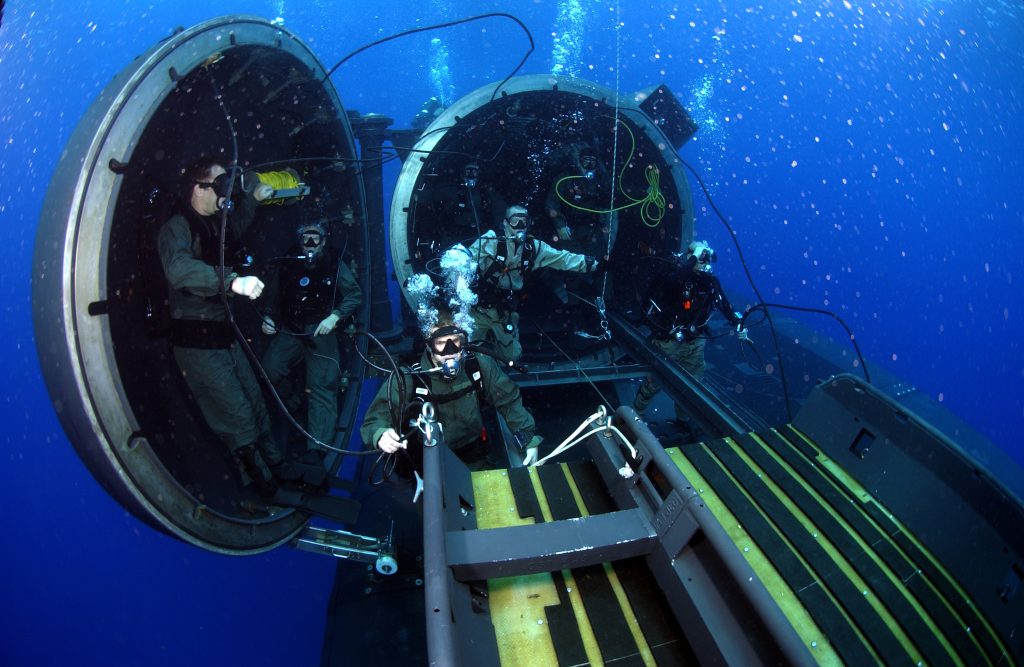
Navy divers and special operators attached to SEAL Delivery Team (SDV) 2, perform SDV operations with the Ohio-Class nuclear-powered guided-missile submarine USS Florida (SSGN 728) for material certification. Material certification allows operators to perform real-world operations anytime, anywhere.
NATO’s Centre for Maritime Research and Experimentation is developing sensors, perception algorithms, autonomy algorithms, and networked uncrewed capabilities for naval mine detection. CMRE emphasizes that autonomous mine countermeasures increase speed, reduce operator risk, and move personnel away from minefields.
NATO is also working on interoperability. CMRE’s Maritime Unmanned Systems Enablers effort focuses on command-and-control standards, underwater communications, modeling and simulation, and exercises such as Baltic Sentry, REPMUS, Dynamic Messenger, and CWIX.
REPMUS and Dynamic Messenger have become major proving grounds for unmanned maritime systems. In recent exercises, more than 2,000 participants from 22 NATO nations and observers were involved, with uncrewed systems tested for missions such as communications resilience, undersea infrastructure support, and mine countermeasures.
The United Kingdom is also moving from conventional mine clearance toward autonomous mine-hunting systems. UK programs include uncrewed surface vessels, minehunting payloads, remote command centers, and systems that emit magnetic, electric, and acoustic signatures for mine countermeasures.
Belgium and the Netherlands are fielding a major robotic mine-countermeasure architecture through Belgium Naval & Robotics, a Naval Group and Exail consortium. The program includes 12 mine-countermeasure vessels, roughly 100 drones, command-and-control containers, USVs, AUVs, towed sonars, remotely operated vehicles, and expendable mine-neutralization systems.
The allied pattern is unmistakable: mine warfare, undersea infrastructure protection, distributed sensing, autonomous payload delivery, and interoperable command-and-control are becoming shared priorities across NATO.
Why Northeast U.S. manufacturing is strategically positioned
The Northeast has a rare combination of maritime defense engineering, submarine industrial base experience, unmanned systems activity, precision manufacturing, and proximity to Navy technical centers.
Key anchors include:
| Northeast / nearby defense anchor | Why it matters to USV and UUV manufacturing |
|---|---|
| HII Uncrewed Systems, Pocasset, Massachusetts | Produces REMUS-family UUVs and delivered the first Lionfish UUVs to the Navy; HII says Lionfish production could scale to 200 vehicles. |
| NUWC Division Newport, Rhode Island | Navy center for submarine warfare and the undersea battlespace, supporting research, development, test, evaluation, engineering, and fleet support. |
| Anduril, Quonset Point, Rhode Island | Announced a manufacturing facility for Dive-LD autonomous undersea vehicles, with planned capacity exceeding 200 hulls per year. |
| General Dynamics Electric Boat, Groton, Connecticut, and Quonset Point, Rhode Island | Core submarine industrial-base presence that strengthens regional talent, suppliers, welding, machining, inspection, and naval manufacturing capacity. |
| Raytheon, Portsmouth, Rhode Island | Supports the AN/AQS-20 minehunting sonar associated with the Navy MCM USV ecosystem. |
| L3Harris / OceanServer, Fall River, Massachusetts | Regional AUV manufacturing and engineering presence supporting autonomous underwater vehicle capabilities. |
| BlackSea Technologies, Baltimore, Maryland | Supports the Navy’s small USV program and GARC production from the Mid-Atlantic corridor. |
This corridor matters because unmanned maritime systems are not built by one prime contractor alone. They depend on a layered industrial base: electronics, magnetics, machining, sheet metal, welding, coatings, cables, composites, batteries, sensors, propulsion, controls, software, test equipment, and sustainment.
The Department of Defense’s National Defense Industrial Strategy highlights resilient supply chains, workforce readiness, flexible acquisition, and the ability to deliver capabilities at speed and scale. For USVs and UUVs, those goals translate directly into more qualified regional suppliers.
How electronic coils and transformers support USV and UUV fleet growth
Electronic coils, transformers, inductors, and custom magnetics are easy to overlook because they are buried inside power supplies, converters, filters, drives, and sensor systems. But they are essential to unmanned maritime platforms.
Custom magnetics support power conversion
USVs and UUVs need efficient power conversion between batteries, generators, payloads, sensors, communications systems, propulsion controllers, navigation systems, and onboard computers. Custom transformers, inductors, chokes, and current-sensing coils help regulate, isolate, filter, and condition that power.
In practical terms, Northeast manufacturers of electronic coils and transformers can support:
- DC/DC converters for batteries, payloads, and mission computers
- Isolation transformers for sensitive electronics and safety-critical circuits
- EMI/RFI chokes to reduce interference between radios, sonar, sensors, and power electronics
- High-frequency transformers for compact power supplies
- Motor-drive inductors for propulsion and actuator systems
- Current sensors and wound components for battery monitoring and power management
- Ruggedized coils and solenoids for valves, locks, release mechanisms, and actuators
- Magnetic-signature or mine-countermeasure-related payload hardware, where applicable and publicly authorized
Mine-countermeasure platforms highlight why this matters. The Navy’s MCM USV includes propulsion, power generation, communications, radar, cameras, navigation, modular payload systems, minehunting sonar, and minesweeping payloads. The UK’s autonomous mine-hunting portfolio also includes systems that emit magnetic, electric, and acoustic signatures for mine countermeasures.
Those are magnetics-intensive environments.
Domestic coil and transformer production reduces lead-time risk
The immediate fleet-growth problem is not only design. It is supply. Long lead times on custom magnetics can slow production of power supplies, propulsion electronics, payload interfaces, chargers, sensor electronics, and test systems.
Domestic coil and transformer manufacturers can help by providing:
- Faster prototype-to-production turns
- Engineering collaboration during design-for-manufacturing
- ITAR-aware and defense-compliant production workflows
- Better lot traceability and configuration control
- Second-source options for vulnerable parts
- Obsolescence management for long-life maritime platforms
- Rugged potting, sealing, insulation, and thermal management for harsh marine environments
For USVs and UUVs, a “small” electromagnetic component can become a production bottleneck. Regional suppliers that can qualify and repeatably produce these components are strategic assets.
How precision machined parts support USV and UUV production
Precision machining is central to unmanned maritime systems because these vehicles must survive motion, pressure, corrosion, shock, vibration, and repeated launch-and-recovery cycles.
For UUVs, machined components often support watertight integrity, alignment, propulsion, payload modularity, and serviceability. For USVs, machined parts support drivetrains, payload mounts, radar masts, brackets, steering systems, sensor housings, hinges, deck hardware, and launch-and-recovery interfaces.
Northeast precision machine shops can support USV and UUV growth through:
| Machined component category | USV/UUV application |
|---|---|
| Pressure housings and end caps | UUV electronics, batteries, sensors, navigation modules |
| Payload rails and modular brackets | Rapid payload swaps for ISR, MCM, EW, ASW, survey, and test missions |
| Thruster, propulsor, and shaft components | Propulsion, steering, endurance, and maintainability |
| Wet-mate connector hardware and penetrator supports | Underwater power, data, and sensor interfaces |
| Battery trays and electronics frames | Shock-resistant packaging and serviceability |
| Sensor mounts and alignment fixtures | Sonar, camera, radar, lidar, antennas, and navigation packages |
| Launch-and-recovery hardware | Shipboard, pier-side, containerized, or shore-based deployment |
| Test fixtures and ground-support equipment | Production acceptance, calibration, depot support, and repair |
The most valuable shops will be those that can handle corrosion-resistant aluminum, stainless steel, titanium, engineered plastics, copper alloys, and specialty materials while maintaining traceability, documentation, and repeatable tolerances.
How metal fabrication supports unmanned maritime systems
Metal fabrication is equally important. The Navy’s MCM USV is publicly described as an all-aluminum vehicle with modular payload capacity, long endurance, and launch-and-recovery flexibility from littoral combat ships, vessels of opportunity, or shore.
That points directly to demand for qualified metal fabrication.
Northeast metal fabricators can support:
- Aluminum hull sections and marine structures
- Welded frames, brackets, skids, and equipment bases
- Electronics cabinets and EMI-shielded enclosures
- Radar, antenna, camera, and sensor masts
- Battery boxes and power-electronics housings
- Payload cradles and mission-module structures
- Containerized command-and-control hardware
- Launch, recovery, transport, and maintenance fixtures
- Depot repair parts and structural spares
For USVs, fabrication often has to balance weight, corrosion resistance, stiffness, payload flexibility, and maintainability. For UUVs, fabricated and machined structures must fit tightly inside limited envelopes while supporting modular payloads, buoyancy, battery packaging, and pressure-boundary interfaces.
As fleets grow, demand shifts from “Can you build one?” to “Can you build 50, 100, or 200 with the same quality, documentation, and lead time?”
The immediate manufacturing need: from prototypes to repeatable production
The most important change in the USV and UUV market is the move from demonstration to repeatable manufacturing.
A prototype can survive with heroic engineering. A fleet cannot.
To increase the U.S. fleet of unmanned surface and undersea vehicles, the industrial base needs:
1. Production-ready subassemblies
Primes and platform builders need suppliers that can deliver complete, inspected subassemblies rather than loose parts. Examples include transformer assemblies, power-filter modules, machined battery trays, welded equipment frames, payload brackets, electronics boxes, and test fixtures.
2. Faster engineering change cycles
USV and UUV platforms are still evolving. Mission payloads, sensors, autonomy packages, communications, batteries, and launch methods change quickly. Suppliers that can support rapid revisions without losing configuration control will have an advantage.
3. Domestic second sources
The defense industrial base needs resilience. Domestic second sources for coils, transformers, machined parts, and fabricated structures reduce schedule risk and help programs avoid single points of failure.
4. Maritime ruggedization
Salt fog, shock, vibration, galvanic corrosion, sealing, thermal cycling, pressure, and electromagnetic compatibility are not optional details. They are production requirements.
5. Sustainment capacity
Fleet growth creates maintenance demand. Every USV and UUV will need spare parts, replacement enclosures, repaired modules, depot kits, upgraded payload brackets, test fixtures, and life-cycle support.
Mission-by-mission manufacturing demand
Mine countermeasures
Mine countermeasures are one of the strongest public use cases for maritime autonomy. The Navy’s MCM USV takes sailors out of the minefield while carrying minehunting and minesweeping payloads. NATO and allied programs are also heavily focused on autonomous mine detection, classification, and neutralization.
Manufacturing demand: magnetic components, acoustic-related payload structures, sonar mounts, aluminum fabrication, launch-and-recovery hardware, rugged electronics enclosures, precision-machined sensor frames.
ISR and maritime domain awareness
Small USVs such as GARC and sUSV Next support fleet experimentation, surveillance, distributed sensing, autonomy, and collaborative behaviors.
Manufacturing demand: radar masts, camera mounts, antenna brackets, electronics boxes, battery structures, power filters, transformers, machined payload interfaces.
Undersea warfare and seabed missions
Large-displacement UUV efforts, REMUS/Lionfish, and DARPA Manta Ray point to longer-duration undersea operations, modular payloads, and persistent undersea presence.
Manufacturing demand: pressure housings, buoyancy-compatible structures, thruster hardware, battery trays, wet-mate connector hardware, custom magnetics for power conditioning, payload frames.
Special operations
SOF AT&L needs modular, expeditionary, low-signature, open-architecture surface and undersea systems.
Manufacturing demand: compact machined structures, mission-specific brackets, rugged power electronics, low-volume precision fabrication, portable launch-and-recovery systems, rapid-turn prototypes.
NATO interoperability and allied exercises
NATO’s work on STANAG 4817, underwater communications, REPMUS, Dynamic Messenger, and networked autonomy shows that allied systems must increasingly connect across platforms and national fleets.
Manufacturing demand: modular enclosures, standard interface panels, ruggedized communications hardware, test adapters, swappable payload structures, containerized C2 support equipment.
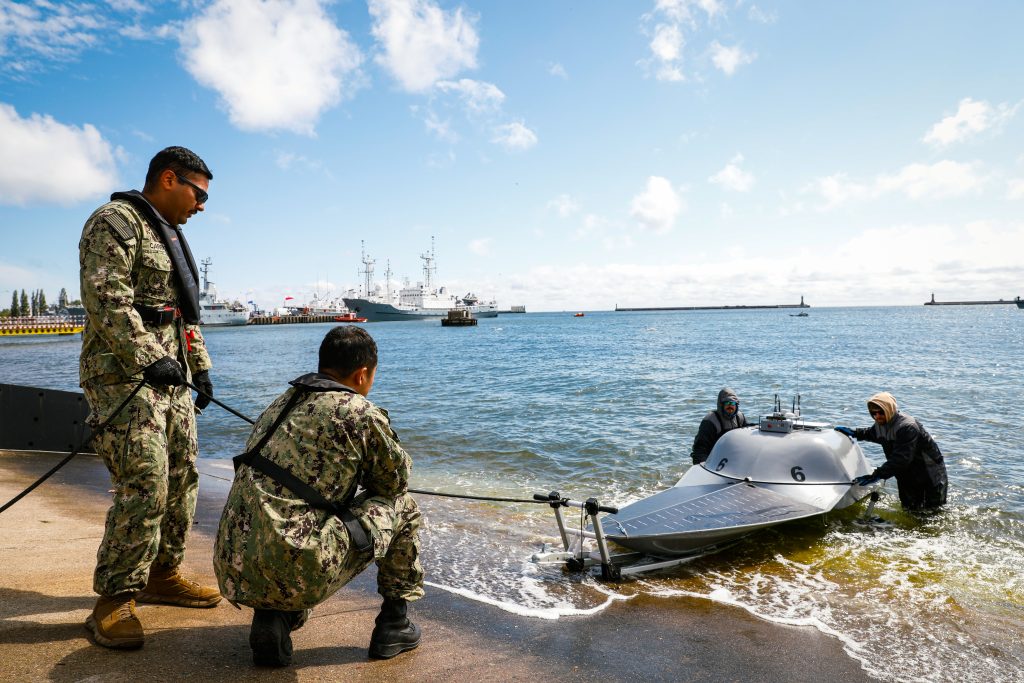
U.S. Navy Seamen carefully retrieve an Unmanned Surface Vessel (USV) from the water during exercise Arcane Thunder 25, 16 May, 2025, at Port Wojenny Gdynia, Poland. Exercise Arcane Thunder 25 is a collaborative U.S. Army Europe directed, 2nd Multi-Domain Task Force led exercise designed to leverage the robust warfighting capabilities of the U.S., Allies, and partner nations to reach a precise, lethal end point. (U.S. Army photo by Spc. Jennifer Posy)
Why domestic Northeast suppliers should act now
The window is open because unmanned maritime systems are scaling before every supplier category has consolidated. Large primes and venture-backed defense companies need reliable regional partners that can meet defense expectations without moving at traditional shipbuilding speed.
For manufacturers of electronic coils and transformers, this is an opportunity to become embedded in power conversion, propulsion electronics, battery systems, EMI filtering, payload electronics, and test equipment.
For precision machine shops, the opportunity is pressure-rated housings, payload rails, propulsor components, battery packaging, launch hardware, mission-module parts, and spares.
For metal fabricators, the opportunity is aluminum structures, electronics cabinets, sensor masts, modular payload frames, launch-and-recovery equipment, maintenance fixtures, and rugged containerized systems.
For Northeast suppliers specifically, the advantage is proximity to Navy undersea engineering, New England UUV production, Rhode Island and Connecticut naval manufacturing, Massachusetts autonomy companies, and the broader Northeast and Mid-Atlantic maritime defense corridor.
Supplier readiness checklist for USV and UUV manufacturing
Manufacturers that want to support USV and UUV programs should prepare for the following:
- Defense traceability: material certs, lot control, revision control, inspection records, and configuration management.
- Cybersecurity readiness: controlled technical information, secure file transfer, access control, and preparation for defense cybersecurity requirements.
- Quality systems: ISO 9001, AS9100, or customer-specific quality controls depending on program requirements.
- Maritime environmental performance: corrosion resistance, sealing, salt fog, thermal cycling, shock, vibration, and water exposure.
- EMI/EMC awareness: especially for coils, transformers, power electronics, sonar, radios, and autonomy hardware.
- Rapid prototyping with production discipline: fast first articles that do not sacrifice documentation.
- Design-for-manufacturing support: early engineering feedback that reduces cost, weight, part count, and lead time.
- Scalable capacity: the ability to move from five parts to 50, 500, or recurring monthly builds.
- Sustainment planning: repair parts, redesign support, obsolescence management, depot kits, and long-term spares.
- Export-control awareness: ITAR/EAR processes where applicable.
Bottom line: USV and UUV fleet growth depends on the industrial base
The United States and its allies are not merely experimenting with unmanned maritime systems. They are building the next layer of naval force structure.
DIU and the Navy are testing production readiness for small USVs. NAVSEA is fielding mine-countermeasure USVs and transitioning UUV programs such as Lionfish into production. DARPA is proving new design models through Manta Ray and NOMARS. SOF AT&L is seeking expeditionary and modular unmanned maritime systems. DTRA’s counter-WMD and emerging-threat mission creates demand for specialized payloads and rugged sensing packages. NATO is making interoperability, mine warfare, and autonomous maritime operations a shared alliance priority.
That entire ecosystem depends on domestic manufacturing.
For Northeast U.S. manufacturers of electronic coils, transformers, machined parts, and metal fabrication, the opportunity is immediate: help turn prototypes into fleets. The companies that can deliver rugged, traceable, production-ready components will help close one of the most important gaps in American maritime power—scaling unmanned systems fast enough to matter.
FAQ: USV and UUV Manufacturing
What is a USV?
A USV is an unmanned surface vehicle. It operates on the water’s surface and can support missions such as surveillance, mine countermeasures, logistics, electronic warfare, communications relay, and maritime domain awareness.
What is a UUV?
A UUV is an unmanned undersea vehicle. UUVs operate underwater and can support missions such as mine countermeasures, seabed mapping, intelligence collection, anti-submarine warfare support, inspection, survey, and payload delivery.
Why does the U.S. Navy need more USVs and UUVs?
The Navy needs more distributed, persistent, lower-risk maritime capability. USVs and UUVs can extend sensing, reduce sailor exposure, support contested operations, and increase fleet capacity without requiring every mission to be performed by a crewed ship.
How do electronic coils and transformers support unmanned maritime systems?
Electronic coils, transformers, inductors, and chokes support power conversion, isolation, EMI filtering, battery systems, propulsion electronics, mission payloads, and sensor electronics. They are essential to reliable power and signal performance in harsh maritime environments.
Why are machined parts important for UUVs?
UUVs need precision-machined pressure housings, end caps, thruster components, payload mounts, battery trays, connector hardware, and alignment fixtures. These parts must often survive pressure, corrosion, vibration, and tight packaging constraints.
Why is metal fabrication important for USVs?
USVs require fabricated hull structures, aluminum frames, payload supports, electronics enclosures, radar and camera mounts, launch-and-recovery hardware, and maintenance fixtures. The Navy’s MCM USV is publicly described as an all-aluminum, modular, semi-autonomous platform, which highlights the importance of marine fabrication.
Why is the Northeast U.S. important for USV and UUV manufacturing?
The Northeast has Navy undersea expertise, submarine industrial-base infrastructure, UUV production, AUV manufacturing, precision machining, electronics manufacturing, welding, fabrication, and proximity to organizations such as NUWC Newport, HII Pocasset, Anduril Quonset Point, Electric Boat, Raytheon Portsmouth, and L3Harris/OceanServer.